Monday, March 8, 2010

Male Sex Scripts & Male Gaze- Sex&Media Final

Male Script & Male Gaze

One’s society is influenced by and reflects in our media. The question becomes does the media influence our society or is the media just a reflection of what our society is already? We believe that the media has an influential power over our society, but it is also a reflection of what already exists in our society is. This is an endless cycle that perpetuates.

Throughout history our society has always been a patriarchal society, where males dominate over women. The media reflects this society ideology and at the same time encourages it. According to Kimmel (2009), “The media reflects existing gender differences and gender inequalities, constructs those very gender differences, and reproduces gender inequality by making those differences seem ‘natural’ and not socially produced in the first place (p.290)”. This ideology of males dominate over women is seen over and over again in the media. We see this by the display of sexual scripts and the male gaze.

As people interact with media, they learn what is appropriate in society. They also learn what is appropriate for their gender according to their sexual scripts. According to Markle (2008), “The concept of ‘sexual scripts’ refers to the idea that sexuality is learned from culturally produced messages that define what sex is and explain how to recognize sexual situations and how to behave in such situations” (p.46). Males behave differently according to the script they were raised and enforced by the surrounding society’s media. According to Markle (2008), “The typical sexual script for men includes the active pursuit of sexual partners, peer validation of sexual activity, inability to control sexuality once aroused, and sex undertaken solely for the sake of pleasure (Frith and Kitzinger 2001, p.214).” (p.47)

Sexual scripts can teach men how to act, behave, and live in patriarchal society. Males learn their sexual scripts through the male gaze. According to Mulvey, “The determining male gaze projects its phantasy on to the female form which is styled accordingly. In their traditional exhibitionist role women are simultaneously looked at and displayed, with their appearance coded for strong visual and erotic impact so that they can be said to connote to-be-looked-at-ness”. As quoted by Monk-Turner, according to Mulvey, “Gazing has been defined by patriarchal society as a male activity while being looked at is the domain of females (p.202)”. In television and films today characters have different point of view (POV) in which they tell the story to the audience which sets the mood and gaze. The audience identifies with the main character by viewing the same “gaze”.

By framing the point of view for the audience identifies with the characters gaze. The male gaze when viewed in media demonstrates how a male views an object, person, or thing. According to Richard Barsam (2007), “The dominant neutral POV gives us the facts and background that are the context in which the character live” (p.184). The point of view helps us understand the characters more in depth by allowing us to view things through their eyes. Barsam explains how camera angles can enhance the meaning through the point of view. High-angle shots are created to make the implication that the one looking down has superiority while low-angle shots are made to imply that one is weak and defenseless (Barsam, 2007, p. 171). These angles not only support the point of view but they also reinforce the male gaze.

Male scripts are important to discuss because it perpetuates the male gaze, influences our society norms, and it is reinforced by the media. Males and females are raised according to the scripts that one is given by society and media.

These five images above displayed through the male gaze reinforce and promotes the male script in our society.
1- Vogue- Labrone James
This magazine cover displays to men how males are supposed to look and what their goal should be to become male. The male gaze portrays a masculine active male who is dominating a passive pettiet woman who is less threatening. The male is in an active pose and the female is in passive pose. Which, this magazine cover is reinforcing these sexual scripts where the male is active and dominates over the passive female.


2- Sky Vodka
In this ad a man is standing over a female, which the viewer is experiencing the male gaze because it is the view of the man. The viewer can identify as the man because he has no face. The woman is positioned under the man in a valuable way. She is directly below his crotch stuck between his legs. From this ad males can learn their sexual script through the male gaze because the male is dominant and in control of the female.


3- Condom ad
Media’s condom ad is reinforcing the message of male domination. The ad says “The tough part isn’t getting her to say yes. It’s getting her to stop saying yes.” This is perpetuating the male script because it is reinforcing this ideology that males need to have sex with women and it is the male’s job to convince women to have sex with them. This ad is teaching males to engage in heterosexual intercourse and they need to pursuit women. Also in this ad the male is on top of the woman, which is showing that males are dominant over females, when it comes to sexuality. When males view this ad they can learn their sexual scripts of convincing women to have sex with them and being dominant over females.

4- WB clip- 3 some Gossip Girl 1:14 min.
The angles in this film display who the viewer is supposed to identify with. As we see in this clip the camera focuses on the male then focuses on the two females. As the camera focuses on the male, the viewer is identifying with him. The male is encouraging the threesome by smiling and proceeding. As the camera focuses on the two females, the viewer is experiencing the male gaze because the viewer is identifying with him. The camera angles allow viewers to experience what the male character is seeing. As viewer watches this clip they are learning male’s sexual script through the male gaze. Through the male gaze, the males can learn that it is exactable to engage in a threesome with two females.
http://www.youtube.com/watch?v=yiprYiui_3c


5- Scandal Hits Florida’s UCF College Campus by Paul F. Davis
The last artifact that we found was an article in The College Press titled “Scandal Hits Florida’s UCF College Campus”. The article discusses that 15 members of Beta Theta Pie fraternity at UCF, raped an intoxicated female student. The female was passed out then she woke up to find 15 guys naked around her, telling her to perform oral and vaginal sex with them. This article is a real life situation and these 15 men are being charged with rape. The question we have to point out is why are these men being charged for this behavior? As we see over and over again in the media it is okay for men to be dominant and have control over women. The media teaches men their sexual scripts through the male gazes, which men learn their roles in society and act on the behaviors they have learned.
http://www.thecollegepress.com/content/view/3594/ ]


6- Circle of reinforcement.
This is how the artifacts become connected. Media often reflects society by creating and supporting an ideology. Media and our society impacts individuals and their male gaze by making the audience view media/images through a male gaze. Typically a male gaze is used in media because of our patriarchy society. Once the male gaze is viewed by individuals their beliefs form about the male script based on the male gaze and media’s influences. These four terms can be connected in a circle that demonstrates how they affect one another. The terms are interchangeable in the circle because they are nonlinear. The four terms don’t have to connect in a straight line and be linear.

Today in our society we see perpetuating cycle where society influences the media, the media teaches sexual scripts through the male gaze. This perpetuating cycle is nonlinear because society, media, sexual scripts and male gazes can all influence and reflect one another. For example, look at our five media artifacts. The Vogue magazine cover with Labrone James is teaching males sexual scripts where the male is active and dominates over the passive female. Males can also learn their sexual scripts from the media with the male gaze, like the threesome scene from Gossip Girl. As males learn their sexual scripts from the male gaze, they are learning that males are dominate and are in control of sex. As males learn this kind of behavior, they act on this kind of behavior like rapping a female from UCF. This is an example of perpetuating cycle of a patriarchy.

This perpetuating cycle of a patriarchy is nonlinear, which means one thing can influence or reflect one another. Let’s use another example starting with society. The 15 members of Beta Theta Pi fraternity at UCF raped an intoxicated female student. Which, this create the ideology that males are males are dominate and are in control of sex, which then it influences the media. The media produces ads like the condom ad and Sky Vodka ad, which both are setting up male’s sexual scripts and male gazes. Society, media, sexual scripts and male gazes can all influence and reflect one another.

Reference
Barsam, R. (2007). Looking at Movies: An Introduction to Film (2nd ed.). New York: W. W.
Norton & Co.

Davis, P. (2009). Scandal Hits Florida’s UCF College Campus. The College Press from
http://www.thecollegepress.com/content/view/3594/

Kimmel, M. (2009). The Gendered Society (4th ed.). New York: Oxford University Press.

Monk-Turner, E. (2008). Who is gazing at whom? A look at how sex is used in magazine
advertisements. Journal of Gender Studies, volume 17:3 (p.201-209).

Mulvey, L. (1975). Visual Pleasure and Narrative Cinema. From:
https://wiki.brown.edu/confluence/display/MarkTribe/Visual+Pleasure+and+Narrative+Cinema

Images:
Vogue: http://media.photobucket.com/image/sexuality%20in%20vogue%2020media/Spreaditdotorg3/lebron_vogue-gisel.jpg

Sky Vodka:
https://blogger.googleusercontent.com/img/b/R29vZ2xl/AVvXsEg_iM3TPA0DIEuvi4pgTrai3xJydYLMUBfc_G_leggAcYkHPKAm0Vgg1VCxCvoD3rwZEwhaIj2_AkrgrdQMeqmSBCLcqnjFP7WMKpAw69W1GFTGJYW7yAllnC6E5qMBN9tXD_IUP6dKYxA/s400/skyy.jpg


Condom ad:
http://adoholik.com/pics/ksad2_large.jpg

Gossip Girl: Threesome on youtube
http://www.youtube.com/watch?v=yiprYiui_3c

Monday, March 1, 2010

Responce to Becca's Masuculinity Sexualized blog

http://raltman.blogspot.com/
Responding to Becca’s Masculinity Sexualized

The construction of masculinity is defined not only in Becca’s blog but it is reinforces, according to Becca, by media and its images. The cultivation theory would explain how television/media repeats our culture’s stereotypes/myths/ideologies. The female gaze is then discussed to support the Vogue cover with Lebron James. I do agree that James is being objectified on the cover but the text around the image indicates why he is posed on the cover. The issue is addressing how to obtain a great body and how to diet. Becca does state that this is a female targeted magazine and that James does not really fit the cover; but when the media thinks about masculine words like body strength the idea falls towards masculinity. These types of words fall towards masculinity because of male scripts and what males are associated with.

Adding one female to a dominating male photo does reinsure the heterosexual masculinity. By adding the female in the Twilight cast also demonstrates the power men have over women. How men always “outweigh” women in media or in the work force (specially viewed in media as a myth). Even though the woman is added into the photography to reinsure of the heterosexual nature of the photo the woman is also there to display a balance physically in the picture. She divides the males in the photo.

I disagree with Becca’s response to the pictures of 50 Cent, Zac Efron and Justin Timberlake. She said, “All three of these men are not showing any emotions on their faces…” In the 50 Cent image he is compensating his tough facial expressions with a reinforcing gun to symbolize that his is tough/strong “a man”. The Zac Efron image depict him as being innocent/ non-threatening as he plays with a ring on his finger and is gazing down. Efron is mysterious in this poise and I believe the way he is looking down is supposed to be inviting to the female eye because he is not “taking us on” in a dominant manner. In GQ Justin Timberlake is expressing a blank direct gaze out toward the viewer; almost making direct eye contact referring to a “bring it on” look. Becca did not look deeper into these last three images. She should have studied them more to understand how other viewers might understand the media images instead of lumping the three images together.

Overall I do agree with Becca’s blog about masculinity and how it is portrayed in media. The reinforcement of masculinity is strong in our culture. The ideology is often not questioned by others and the social norm of masculinity may take many years to change or develop. With media’s strong reinforcement of what is normal for masculinity one may never think of other possibilities of depicting masculinity.

Thursday, February 18, 2010

2-24-2010 sexuality minorities, “sexual otherness” and heterosexism in media


http://laist.com/attachments/la_zach/gay_rights_memo.jpg


http://www.inquisitr.com/wp-content/adam-lambert-gay.jpg


http://i236.photobucket.com/albums/ff37/HarleyDad69/Sexy%20Graphics/LESBIANS.jpg


http://msp233.photobucket.com/albums/ee27/first_kiss/lesbians.jpg

http://bossip.files.wordpress.com/nelly-tipdrill.jpg

From the reading I learned about sexual minorities. Most of the readings focused on homosexuality between gay males and female lesbians. I wanted to try and find some ethnic images of different races viewed in a sexual manner because that is harder to find than homosexual images. Lesbianism is encouraged by heterosexual males, lesbian are seen as a turn on. Gay men are being viewed in media more because of the debate about Gay Marriage.

I was disappointed when I couldn’t find any images of different ethnicity viewed in a sexual manner other than in music, movies, or some magazines. I wanted to find images that were mainstreamed for African-American, Latino, or other races. I wanted to examine what influenced them. But after an hour of searching I decided to just choose mostly homosexual images.

The first two images from the top are homosexual male couples. The top first image made me stop and think; this image looked like two heterosexual males. When viewing other images I noticed that there were common stereotypes within the images. Either the men looked like heterosexual/commonly dressed men or they were depicted as being feminine. When I say the gay men were depicted as feminine I mean that the men were wearing make-up or dressed outside of their gender norm in bright colors and/or costumes.

The lesbian images on the other hand were there for pleasure. All the images I viewed of lesbians were seductive kissing/embracing or posing for the viewer. Lesbians are viewed as a fantasy for heterosexual males. The two images that I have chosen support my last claim and these images were common.

The top lesbian couple seems to be viewed by a “male gaze”. They are directly looking out at the viewer. The lesbian couple is about to embrace one another but they have stopped in a seductive manner to look up at you, the viewer. Also notice how both of these lesbian couples are wearing some kind of lingerie. Most of the images depicting lesbians had some kind of lingerie on, never fully nude.

The last image I have chosen was Nelly, a music rap/hip hop artist, who is known for his sexualized lyrics and music videos. In this image the women are in bikinis. Nelly is displaying his heterosexuality through proving his sexuality in his music videos. There are no fully nude males or females that I could find that were of another race depicted in a sexual act with another person.

When searching for sexual pictures of different races it was hard to find ones that were not bias, racist, offensive, or “poking fun” at how other races are depicted sexually. I thought it would have been easy to find images of a Latino couple being sexual, but it was not.

Sunday, February 14, 2010

Thursday, February 4, 2010

2-10-2010 Masculinity as specifically sexualized


http://media.photobucket.com/image/sexuality%20in%20vogue%20media/Spreaditdotorg3/lebron_vogue-gisel.jpg


https://blogger.googleusercontent.com/img/b/R29vZ2xl/AVvXsEg_iM3TPA0DIEuvi4pgTrai3xJydYLMUBfc_G_leggAcYkHPKAm0Vgg1VCxCvoD3rwZEwhaIj2_AkrgrdQMeqmSBCLcqnjFP7WMKpAw69W1GFTGJYW7yAllnC6E5qMBN9tXD_IUP6dKYxA/s400/skyy.jpg


http://adoholik.com/pics/ksad2_large.jpg


I'M Real (Ja Rule and Jennifer Lopez)

Are you early
(Miss Mary Jane, I'm analyzin' the game)
End the games, unchose me
(To bring pain, pretty women, and fake thugs, one in the same)
Ever since you told me
(There's only room for two, I'll be makin' less room for you)
Now only God can hold me
(Hug me, love me, judge me, the only Man that hugs is above me, holler)

I met so many men
And it's like their all the same
My appetite for lovin'
Is now my hunger pain

And when I'm feelin' sexy
Who's gonna come for me
My only problem is
Their insecurity

(Tired of bein' alone) Yeah, yeah
(See you arguin' on the phone) Yeah, yeah
(Are you tellin' all your friends) Yeah, yeah
(That your n**** don't understand) My love

'Cause I'm real
(The way you walk, the way you move, the way you talk)
'Cause I'm real
(The way you stare, the way you look, your style, your hair)
'Cause I'm real
(The way you smile, the way you smell, it drives me wild)
'Cause I'm real
And I can't go on without you

Girl, I've been thinkin' 'bout this relationship
And I wanna know is this as good as it gets
'Cause we've been through the worst times and the best times
But it was our time, even if it was part-time
My baby lookin' at me, smilin' at me, laughin' like we wasn't happy
But not knowin', ever growin' and we're gettin' married
Hard lovin', straight thuggin'
Baby, I ain't doin' this here for nuttin'
I'm here to get it poppin', hop in, let's ride up in the Benz
Hair blowin' in the wind, sun glistenin' off my skin,
hey
I'm nasty, heh, you know me
But you still don't be feelin' me, baby

'Cause I'm real
(The way you walk, the way you move, the way you talk)
'Cause I'm real
(The way you stare, the way you look, your style, your hair)
'Cause I'm real
(The way you smile, the way you smell, it drives me wild)
'Cause I'm real
And I can't go on without you

Now people lovin' me and hatin' me, treatin' me
ungratefully
But not knowin' that they ain't makin' or breakin' me
My life I live it to the limit and I love it
Now I can breathe again, baby, now I can breathe again

Now people screamin' what the deal with you and so and so
I tell them n****s to mind they biz, but they don't hear me though
'Cause I live my life to the limit and I love it
Now I could breathe again, baby, now I could breathe again

(Tired of bein' alone) Yeah, yeah
(See you arguin' on the phone) Yeah, yeah
(Are you tellin' all your friends) Yeah, yeah
(That your n**** don't understand) My love

'Cause I'm real
(The way you walk, the way you move, the way you talk)
'Cause I'm real
(The way you stare, the way you look, your style, your hair)
'Cause I'm real
(The way you smile, the way you smell, it drives me wild)
'Cause I'm real
And I can't go on without you

'Cause I'm real
(The way you walk, the way you move, the way you talk)
'Cause I'm real
(The way you stare, the way you look, your style, your hair)
'Cause I'm real
(The way you smile, the way you smell, it drives me wild)
'Cause I'm real
And I can't go on without you

http://www.lyrics007.com/Jennifer%20Lopez%20Lyrics/I'm%20Real%20(Ja%20Rule%20Mix)%20Lyrics.html

The media I have chosen depicts male patriarchy and how women are seen as lower class citizens within our culture. Attwood and Brooks discus how the male body has become a sexual object increasing in our society; but males have not been as objectified as females. Women are being demeaned in media and observed through the male gaze.

The women in the images I have chosen are only a minute reality that I view on a daily basis in my society. The Vogue cover has been an issue for a while. Some compare this cover to King Kong and relate LeBron to Kong who was viewed as an African sexualized beast that couldn’t control his lust for the white Caucasian blonde woman.

Dissecting this Vogue cover I notice how he is towering over the whimsical Gisele in an authoritative masculine manner. LeBron is displayed as a physical man with his mouth open, legs spread in a confrontational manner, while dribbling a basketball, and he is securely holding the woman next to him in a tight manner. Images like this is discussed in Attwood and Brooks; they discuss how men are seen as powerful while women are seen as objectified, weak, or trophies that are there for pleasure. Media messages are giving males scripts for out culture to follow by displaying male models in this way.

The Skyy vodka magazine advertisement is viewed in the same way. The man has control over the woman. The man has no face so we can identify with him or fantasize that we are him. The woman is directly between his legs directly below his dick. She is wearing a small bikini and is looking up at him, taking off her sunglasses to get a better look. This advertisement is seen through the male gaze. Sexual scripts are being laid out and we are expected to read this ad as being appealing. We are supposed to be wanting to be this man.

LongLast condom advertisement states, “The tough part isn’t getting her to say yes. It’s getting her to stop saying yes.” Again males are given ideas about how women are supposed to act toward sex and sexuality. This ad depicts how the woman is only there to please the man. The statement makes it seem like he is forcing her to take pleasure in having sex. This is creating a fantasy not reality according to Brooks.

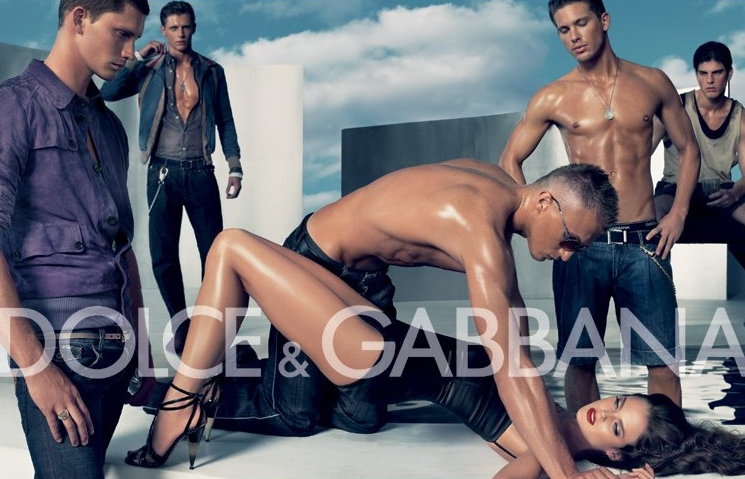
The Dolce & Gabbana image has multiple men surrounding one woman. If I were able to remove the woman this advertisement would look homosexual in nature. But because of that one woman the fantasy is created. A three-some or more; but the three-some would not be encouraged unless it was seen to be a heterosexual act involving a woman. If the woman wasn't involved the masculinity of the men would come into question.

Berkowitz discussed in his study how groups of mixed genders, in porn shops, made the men feel like they had to exaggerate their masculinity to stay masculine. I feel that the Dolce & Gabbana image is doing the same thing; all of these men are looking down at the woman as an object of lust, their interest is directed at the woman, and some have taken off their shirts to become more masculine themselves. The men in this image are obviously the dominating ones who have taken control of the helpless woman.

I also included the lyrics I'M Real (by: Ja Rule and Jennifer Lopez) to this blog because it depict scripts and how (men) “And it's like their all the same”. These lyrics also discuss the lust for sex. Not really love but sex. It goes on to talk about settling because the relationship is not improving. This song is a little confusing because it talks about so many different subjects. It discusses how men are all the same; they have the same “insecurities” or traits. It also goes into how Lopez says she is being “real”.

But what is real? Media is creating rules that we have to follow or else we get teased, bullied, asked about our masculinity/feminity, or looked down upon by our society. These scripts in our society tell us how to think. Right now scripts are beginning to change but we are still encouraged to be heterosexual. Men are encouraged to be the pursuer of women while women are supposed to be the pursued.

Thursday, January 28, 2010

reference page for articles

Reference Page:

Bibliography For SP 410: Sex and Media


Attwood, F. (2005). Fashion and passion: Marketing sex to women. Sexualities, 8(4), 392-406.

Attwood, F. (2005). Tits and ass and porn and fighting: Male heterosexuality in magazines for men. International Journal of Cultural Studies, 8(1), 83-100.

Banks, J. (2003). Prurient Interests: Sexuality, Ideology, and Popular Communication. Popular Communication, 1(1), 5-13.

Berkowitz, D. (2006). Consuming eroticism: Gender performance and presentations in pornographic establishments. Journal of Contemporary Ethnography, 35(5), 583-606.

Brooks, G. (1999). The centerfold syndrome. In S. Maasik & J. Solomon (Eds.), Signs of life in the USA: readings on popular culture for writers (438-447). Boston: Bedford Press.

Brown, J. (2002). Mass media influences on sexuality. Journal of Sex Research 39(1), 42-46.

Collins, R.L., Elliott, M.N., et al. (2003). Entertainment television as a healthy sex educator: The impact of condom-efficacy information in an episode of Friends. Pediatrics, 112(5), 1115-1121.

Coon, D. R. (2005). Two steps forward, one step back: The selling of Charlie’s Angels and Alias. Journal of Popular Film and Television, 33(1), 2-11.

Davidson, A. & Wallack, L. (2004). A content analysis of sexually transmitted diseases in the print news media. Journal of Health Communication, 9(2), 111-118.

Dempsey, J.M., & Reichert, T. (2000). Portrayal of married sex in the movies. Sexuality & Culture, 4(3), 21-37.

Dennis, J. (2003). “Signifying same-sex desire in television cartoons. Journal of Popular Film & Television, 31(3), 132-141.

Dworkin, A. (1992). Against the male flood: censorship, pornography, and inequality. In C. Itzin (Ed.), Pornography: Women, Violence, and Civil Liberties (515-535). London and New York: Oxford University Press.

Hartley, N. (1997). In the flesh: a porn star’s journey. In J. Nagel (Ed.), Whores and other feminists (57-65). New York: Routledge.

Hubbard, R. (2000). The social construction of sexuality. In P. Rothenberg (Ed.), The social construction of difference: Race, gender, class and sexuality (64-67). NY: Worth Publications. (Original work published 1990)

Hunt, A. & Curtis, B. (2006). A genealogy of the genital kiss: Oral sex in the twentieth century. The Canadian Journal of Human Sexuality, 15(2), 69-83.

Huntemann, N. (2004). Pixel pinups: Images of women in video games. In R. Lind (Ed.), Race/Gender/Media: Considering Diversity Across Audiences, Content and Producers (251- 258) Boston: AB-Longman.

Jenkins, T. (2005). “Potential lesbians at two o’clock” : The heterosexualization of lesbianism in the recent teen film. Journal of Popular Culture, (38)4, 491-505.

Jensen, R., & Dines, G. (2004). Pornography in a pornographic culture: Eroticizing domination and subordination. In R. Lind (Ed.), Race/Gender/Media: Considering Diversity Across Audiences, Content, and Producers (274-281). Boston: AB-Longman

Jensen, R. & Jensen, J. (2007). Entertainment media and sexual health: A content analysis of sexual talk, behavior and risks in a popular television series. Sex Roles, (56), 275-284.

Kaufman, F. (2005). Debbie does salad: The food network at the frontiers of pornography. Harper’s Magazine. Accessed at: http://www.barbaranitke.com/harpersmag.html

Keller, S. & Brown, J. (2002). Media interventions to promote responsible sexual behavior. Journal of Sex Research, 39(1), 67-72.

Kim, J., Sorsoli, C.L., et. al. (2007). From sex to sexuality: Exposing the heterosexual script on primetime network television. Journal of Sex Research, 44(2), 145-157.

Kipnis, L. (1992). (Male) desire and (female) disgust: reading Hustler. In L. Grossberg, C. Nelson & P. Treichler (Eds.), Cultural Studies (373-389). New York: Routledge.

Krassas, N., Blauwkamp, J., & Wesselink P. (2003). “Master your johnson”: Sexual rhetoric in “Maxim” and “Stuff” magazines. Sexuality & Culture, 7(3), 98-120.

Levande, M. (2008). Women, pop music and pornography. Meridians, 8(1) 293-321.

Magnet, S. (2007). Feminist sexualities, race, and the internet: An investigation of suicidegirls.com. New Media & Society, 9(4), 577-602.

Markle, G. (2008). “Can women have sex like a man?”: Sexual Scripts in Sex and the City. Sexuality & Culture, 12, 45-57.

Mayer, V. (2005). Soft-core in TV time: The political economy of a “cultural trend”. Critical Studies in Media Communication, 22(4), 302-320.

Menard, D. & Kleinplatz, P. (2007). Twenty-one moves guaranteed to make his thighs go up in flames: Depictions of “great sex” in popular magazines. Sexuality & Culture, 12, 1-20.

McElroy, W. (1995). XXX: A woman’s right to pornography. New York: St. Martin’s Press.

Monet, V. (1999). What is feminist pornography? In J. Elias, V. Diehl Elias, V. Bullough, G. Brewer, J. Douglas & W. Jarvis (Eds.), Porn 101: Eroticism, Pornography and the First Amendment (207-210). New York: Prometheus Books.

Monk-Turner, E., Wren, K., et. al. (2008). Who is gazing at whom? A look at how sex is used in magazine advertisements. Journal of Gender Studies, 17(3), 201-209.

Penley, C. (2004). Crackers and whackers: The white trashing of porn. In L. Williams (Ed.), Porn Studies (309-331). London: Duke University Press.

Shugart, H. (2003). Reinventing privilege: The new (gay) man in contemporary popular media. Critical Studies in Media Communication, 20(1), 67-91.

2-3-10 Mediated examples of femininity as specifically sexualized


http://www.marieclaire.com/cm/marieclaire/images/victorias%20secret.jpg


http://www.amapanet.com/images/img-85a.jpg


http://justsomeasiankid.files.wordpress.com/2009/09/grand_theft_auto_san_andreas.jpg


http://timetunedin.files.wordpress.com/2009/09/116096_0353_pre.jpg


***********Mediated Examples of Femininity as Specifically Sexualized*****************

Markle describes the differences between typical women scripts and typical male scripts. Markle (2008) discusses how the relationships have two sides the approaching dominating typical male and the emotionally passive female who is waiting for her “prince” (p. 47). From this reading I found a lot of images that would represent the typical women script and a couple of images that would challenge how women are supposed to act about/toward sexuality.
The Hugh Hefner picture with all the Playboy girls is a cultural fantasy that men want to achieve. Men in our current culture want to fit into the “typical male script”. The male script is a dominating male who is pursing females (sometimes multiple female), validating their sexuality by bragging about sex/sexual acts, which is not able to restrain oneself around the opposite sex, and uses sex for self fulfilling pleasure. Hugh Hefner is fulfilling this cultural image/fantasy by having multiple girlfriends, presently having twin girlfriends, and being able to express his sexuality to other males through producing Playboy magazines.

Hugh is having these girls crowd around him in bathing suits. This is objectifying the women and portraying them as objects of possession. All the women, if you haven’t noticed, all have the same build, height, weight, and boob size. The women don’t have very different distinguishing characteristics.

The Cougar Town is an example of a woman who is trying to change cultural beliefs about how women are supposed to act about sexuality. The narrative of Cougar Town is an older woman who is breaking the female typical script by pursuing younger men and looking for sexual pleasure rather than a serous relationship. She is pursing the younger males and not the other way around. This is defying what is typical in our culture and most are not used to this idea, yet.

Huntemann’s article discusses video games and how the emerging heroines and female characters are being put into gender norms and given different equipment, powers, or are portrayed differently since they are women characters. Grand Theft Auto portrays women as inferior objectified objects that are used to be killed, have sex with them, and they become the victims. The women are portrayed as objects and are violated. WORLD OF WARCRAFT (WOW) is a little different because the characters are based on status on the game, males and females can be both stripped down to bare underwear or build up armor (depending on their status in the game), and you can command the men/women to do the same things (for example: dance).

The only difference is on WOW the real life women who play female characters on WOW get harassed more because of how they decide to dress/portray their female character online. Sometimes women decide to create male characters online for WOW to avoid the harassment. So women are still being pursued online through discussion talk sessions with men.

Coon’s reading about promotional female marketing and how it's hurting the view about gender relates to Victoria’s Secret, Playboy, and WOW images. Each one of these images is representing the cultures fantasy about what women are supposed to look like and act in a feminized sexual manner. Victoria’s Secret image displays a vulnerable feminized woman who is posed for the male gaze to admire her body. She has the messed up hair, a pushup bra to enhance herself, and the label “Christmas” across her stomach drawing attention. The lettering was meant to draw ones attention to her torso, or breast. The red text on the left hand side says, “Christmas Delivery Guaranteed” allowing for sexual insight into the statement. This marketing method is used to sale underwear in a sexual way. It’s hyper sexualized and objectifying women at the same time; making the women objects to gaze upon.

The Playboy and WOW images use female in the same way to market. Playboy uses multiple women who are attractive, or the ideal fantasy, to draw men into reading Playboy. WOW has women characters that have enhanced breasts and can dance in their underwear if the player wants to command their character to do so. Both of these have male dominating characters that can influence, harass, or command women/characters.

All of these images have femininity that is enhanced and sexualized. In these images women have enhanced breasts, long feminine hair, and have figures that are feminine. They are all women who are portrayed in media as sexual symbols of ideal women. These “ideal women” create our stereotypes of how women are supposed to act about sexuality and this is how typical women scripts are developed.

**See reference page for articles